Currently Empty: $0.00
Forklift Lifting Capacity Explained: How Much Can It Handle?

Every forklift has a limit, and knowing exactly where that limit falls is the foundation of safe, productive material handling. Push a machine past its rated capacity and you risk tip-overs, dropped loads, damaged equipment, and serious injury. Stay well within it, and you get dependable performance shift after shift. Yet lifting capacity is more nuanced than a single number stamped on the frame, since load size, height, attachments, and load position all change what a forklift can truly handle. This guide breaks down how capacity is measured, the factors that affect it, how to read the data plate, how to match a machine to your work, and the mistakes worth avoiding. By the end, you will know precisely how much your forklift can handle and why.
Understanding Forklift Lifting Capacity Ratings
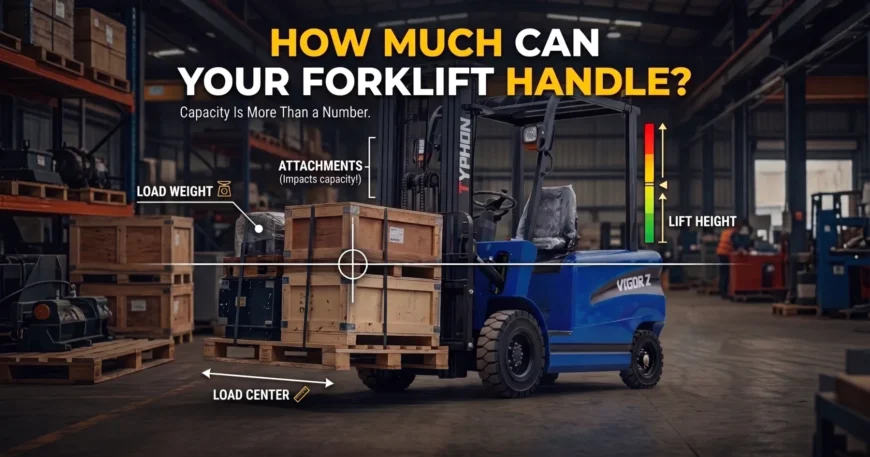
Forklift lifting capacity is the maximum weight a machine can safely raise and carry under a defined set of conditions, and it is expressed as the rated load capacity. This figure is not an estimate or a rough guideline. Manufacturers calculate it through careful engineering that accounts for the forklift's weight, wheelbase, counterweight, and the balance point around the front axle. The result tells you the heaviest load the machine can lift while remaining stable, provided you operate it within the exact conditions the rating assumes. Those conditions are the key to understanding the number correctly. A rated capacity always applies to a specific load center distance and often to a maximum lift height, and it assumes a standard, evenly distributed load. Change any of those variables, and the safe lifting capacity changes with them. A forklift rated to lift 5,000 pounds at a 24-inch load center, for example, cannot safely lift that same weight if the load is larger, positioned farther from the mast, or raised to an unusual height. This is why treating the rated capacity as a fixed, universal limit is a serious mistake. The number represents the machine's ceiling under ideal, specified circumstances, not a guarantee that it will handle that weight in every situation. Understanding capacity means understanding the conditions attached to it. Before lifting, an operator should always ask whether the load, its position, and the intended height match the assumptions behind the rating. When they do, the machine performs safely and predictably. When they do not, the real capacity drops, sometimes sharply, and relying on the headline number alone invites instability. Grasping this principle is the first step toward using any forklift the way it was designed to be used.
Factors That Affect Forklift Lifting Capacity
The rated capacity tells only part of the story, because several practical factors influence what a forklift can actually lift on the job. The most important of these is the load center distance, which is the distance from the face of the forks to the load's center of gravity. Standard ratings typically assume a 24-inch load center. When a load's center of gravity sits farther out, the leverage working against the machine increases, and the safe lifting capacity falls accordingly. A load that is perfectly manageable at 24 inches can become dangerous at 36 inches, even though its weight has not changed. Load size and shape work hand in hand with the load center. Bulky, long, or awkwardly shaped loads shift the center of gravity forward and reduce stability, while compact, evenly distributed loads keep the weight close to the mast where the forklift handles it best. Lift height adds another layer, since raising a load high changes the machine's balance and, on many forklifts, reduces the weight that can be safely carried at full elevation. Attachments and mast configuration round out the picture and are frequently underestimated. Consider how these factors reshape true capacity: Attachments such as side shifters, clamps, or rotators add weight and often move the load center forward, lowering the effective capacity. Lift height can reduce stability and capacity as the load rises, especially on tall masts. Mast configuration, including multi-stage or high-reach masts, affects both the machine's balance and its rated performance at height. Because these factors combine, the actual lifting capacity in your specific application may be considerably lower than the base rating suggests. Evaluating the load, its position, the attachment in use, and the required height together gives you an honest picture of what the machine can safely handle.
How to Read a Forklift Capacity Plate

Every forklift carries a capacity plate, also called the data plate or nameplate, and learning to read it is one of the most valuable skills an operator can develop. Mounted where the operator can see it, usually near the dash or on the mast, this plate is the authoritative source for the machine's safe operating limits. It is required by regulation for good reason, since it translates the manufacturer's engineering into the practical numbers you need before every lift. Ignoring it, or assuming you already know what it says, is how avoidable accidents begin. The plate contains a range of essential information that defines exactly how the machine may be used. Key details you will typically find include: Rated capacity in pounds or kilograms, stating the maximum safe load. Load center distance the rating is based on, usually 24 inches. Maximum lift height and, on many plates, reduced capacities at greater heights. Attachment information, when the machine is fitted with attachments that alter capacity. Fuel type, model, and serial number for identifying the specific machine. Reading the plate correctly means connecting these figures to the job in front of you. If the plate lists a capacity at a 24-inch load center but your load sits farther out, you must recognize that the safe limit is lower than the headline number. When attachments are installed, the plate should reflect the adjusted capacity, and you must operate to that revised figure rather than the machine's original rating. This is precisely how the capacity plate helps prevent overloading, giving operators a clear reference that removes guesswork. Any time an attachment is added or the machine is modified, the plate must be updated to match. Make checking the plate a routine habit, and you keep every lift grounded in verified, manufacturer-approved limits rather than assumption.
Choosing the Right Forklift Capacity for Your Job
Selecting a forklift with the correct lifting capacity is a decision that shapes both your productivity and your safety for years. A machine with too little capacity forces you to split loads, work slowly, or push the equipment to its limits, while an oversized machine costs more to buy, fuel, and maintain than your work requires. The goal is a sensible match between the forklift's rated capacity and the real demands of your operation, with a comfortable safety margin built in rather than a machine constantly working at its ceiling. Start by looking honestly at the materials and loads you handle most often. Identify your average load weight, but pay equal attention to your heaviest routine loads, since those define the capacity you actually need. Factor in the size and shape of what you lift, because bulky loads with distant load centers demand more capacity than their weight alone suggests. If you use attachments, remember that they reduce effective capacity, so choose a machine that still handles your loads comfortably once the attachment is fitted. Your working environment deserves the same careful thought. Consider these elements before you commit: Typical and maximum load weights, planning around the heaviest loads you lift regularly. Lift heights required, since tall lifting can reduce usable capacity. Load dimensions and load center, which affect real-world performance. Aisle width and space, influencing the size and type of machine that fits. Choosing capacity is ultimately about matching the machine to genuine daily conditions rather than to a single number or a best-case scenario. A forklift sized to handle your heaviest routine loads at the heights and reaches you actually use, with margin to spare, delivers safer operation and steadier productivity. Take the time to assess your work accurately, and you invest in equipment that performs dependably without straining against its limits.
Common Forklift Capacity Mistakes to Avoid
Even well-trained operators can fall into capacity-related errors, and these mistakes are among the leading causes of forklift accidents and equipment damage. Overloading tops the list. Lifting more than the rated capacity, or ignoring the reduced capacity that comes with a distant load center or a raised load, compromises the machine's stability and invites a tip-over. The temptation to move one heavy load rather than two safe ones is understandable, but it is never worth the risk to the operator, nearby workers, or the equipment itself. Incorrect attachment use is another frequent and costly error. Attachments change both the weight and the balance of a forklift, and using one without adjusting to the revised capacity, or without an updated data plate, means operating on numbers that no longer apply. Lifting unstable, poorly stacked, or unevenly distributed loads compounds the danger further, since a load that shifts in transit can throw off the machine's balance in an instant. Each of these mistakes shares a common root: operating on assumption rather than verified limits. Avoiding these problems comes down to consistent, disciplined practice. Keep these guidelines front of mind: Never exceed the rated capacity, and account for load center and lift height every time. Match attachments to the adjusted capacity, and confirm the data plate reflects them. Stack and secure loads evenly so the center of gravity stays stable during travel. Inspect the load and the plate before lifting, rather than relying on memory or guesswork. Following proper operating guidelines is what separates safe, efficient handling from preventable incidents. These practices are not complicated, but they demand attention and respect for the machine's limits on every single lift. Build them into your daily routine, and you protect your people, preserve your equipment, and keep your operation running smoothly without the costly disruptions that capacity mistakes bring.
Conclusion
Understanding forklift lifting capacity is essential to running a safe, productive operation, and it goes well beyond reading a single number. Rated capacity applies only under specific conditions, and factors like load center distance, load size, lift height, attachments, and mast configuration all shape what a machine can truly handle. The capacity plate gives you the verified limits for every lift, and learning to read it accurately is one of the most important habits any operator can build. Choosing the right capacity for your materials and environment sets your operation up for dependable performance, while avoiding common mistakes like overloading and improper attachment use keeps your people and equipment safe. Respect the machine's limits, verify before you lift, and operate with discipline, and your forklift will deliver the reliable, safe handling your work depends on.