Wheel Loader
-
Rated 0 out of 5Sale!DISCOVER MORE$37,080.00Original price was: $37,080.00.$0.00Current price is: $0.00. -
Rated 0 out of 5Sale!DISCOVER MORE$16,999.00Original price was: $16,999.00.$0.00Current price is: $0.00. -
Rated 0 out of 5Sale!DISCOVER MORE$10,798.00Original price was: $10,798.00.$0.00Current price is: $0.00.
What is a Wheel Loader?
A wheel loader is the undisputed powerhouse of high-volume earthmoving machinery. Designed to scoop, lift, and transport massive quantities of loose dirt, gravel, and snow, these machines are the backbone of quarries, batch plants, and large commercial developments.
Unlike tracked equipment, a front end loader utilizes articulated steering—pivoting in the center of the chassis—and travels on large pneumatic tires. This design provides rapid cycle times, exceptional maneuverability, and the lift capacity needed to quickly load tandem-axle dump trucks without tearing up finished surfaces.
Why Heavy Contractors Choose Wheel Loaders
It comes down to pure physics: maximizing payload while minimizing friction and fuel burn.
Rapid Roading Speed
Unlike excavators that must be loaded onto a lowboy trailer to move across a large site, wheel loaders can travel at speeds of 25+ mph, driving directly to the next task.
Lowest Cost-Per-Yard
With buckets ranging from 2 to 10+ cubic yards, a single pass from a front end loader does the work of five passes from smaller compact machinery, slashing operator hours.
Fuel & Tire Efficiency
Wheels produce far less ground friction than steel or rubber tracks. This translates to significantly lower fuel consumption and drastically reduced undercarriage maintenance costs.
High-Dump Clearances
The forward-mounted lift arms provide exceptional visibility to the bucket edge and allow for the clearance needed to easily dump over the high side rails of articulated haul trucks.
Industry Applications & ROI
🏗️ Heavy Construction & Site Prep
Wheel loaders are the primary support machines for heavy excavators. While excavators dig the trenches, loaders rapidly backfill them, move heavy trench boxes, and transport bedding gravel across the site efficiently without tearing up the subgrade.
⛏️ Mining & Aggregates
In quarries and batch plants, loaders run non-stop. They are the lifeline that feeds crushers and loads highway trucks with crushed stone, sand, and asphalt. Downtime here halts the entire supply chain, which is why durability is paramount.
🌾 Agriculture & Feedlots
Outfitted with high-capacity grapple forks, mid-size loaders are essential in massive dairy and feedlot operations. They offer the sheer pushing power required to pack silage bunkers tightly and the reach needed to load massive feed mixers.
📦 Material Handling & Waste
Equipped with solid rubber tires and heavy-duty guarding, loaders are deployed in waste transfer stations and scrap yards to push trash, compress loads, and feed industrial incinerators in highly abrasive environments.
Technical Specifications That Drive Profit
Don't buy based on paint color. Buy based on the engineering that lowers your operating costs.
Engine Power & Load-Sensing Hydraulics
Premium loaders feature variable displacement hydraulic pumps. Instead of pumping fluid constantly (which wastes diesel), the system "senses" the load and delivers exact hydraulic flow only when you actuate the joystick. This single feature can save thousands of dollars in diesel over a single operating year.
Full Turn Tipping Load
This is the most critical spec for site safety and performance. Because loaders articulate, their center of gravity shifts when fully turned. The "Full Turn Tipping Load" tells you exactly how much weight the machine can safely hold in the bucket when the steering is fully locked to one side before the rear wheels leave the ground.
Bucket Capacity (Heaped vs. Struck)
A "struck" capacity is the volume of a bucket leveled off flat. "Heaped" assumes the material is piled high. Always calculate your truck-loading times based on the heaped capacity of the specific material density (e.g., wet sand is much heavier than dry topsoil).
Premium Compact Loader Specifications
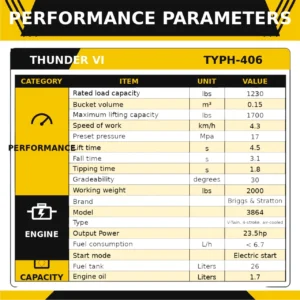
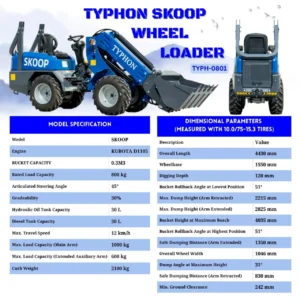
Engineered to tackle heavy workloads with unparalleled efficiency. Here is the benchmark performance you can expect from our 4,600 lb compact class.
| Core Specification | Performance Metric | Job Site Benefit |
|---|---|---|
| Engine Power | 25hp (18.2kw) Water-Cooled Diesel | Maintains peak torque and prevents overheating during continuous, high-load operations. |
| Max Load Capacity | 2,200 lbs (Standard) / 1,320 lbs (Extended) | Moves heavy pallets, block, and dense aggregate efficiently with fewer cycles. |
| Telescopic Boom | +2 Feet of Extension Reach | Allows operators to easily clear the side rails of haul trucks and stack materials higher. |
| Breakout Force | 15 KN (Kilonewtons) | Provides the massive hydraulic prying power needed to dig into compacted dirt and gravel piles. |
| Bucket Capacity | 0.3 cbm (Cubic Meters) | Optimized volume-to-weight ratio ensures rapid material handling without risking a tip-over. |
| Terrain Mastery | 30% Max Gradeability / 242mm Clearance | Prevents the undercarriage from bottoming out on rutted sites and maintains traction on steep slopes. |
Unleashing Versatility with Attachments
Equipped with an ISO quick-coupler, a wheel loader transitions from a dirt-mover to a multi-tool in seconds.
- General Purpose Buckets: The standard for stockpiling dirt and gravel. Usually equipped with bolt-on, reversible cutting edges to extend lifespan.
- Rock Buckets: Built with high-strength AR400 steel, spade noses, and aggressive teeth for penetrating blasted rock in quarries.
- Pallet Forks: Essential for offloading delivery trucks, moving concrete barriers, and handling massive pallets of block safely.
- Grapple Buckets: Features hydraulic jaws that clamp down on uneven loads. Perfect for land clearing, forestry, and disaster cleanup.
- Snow Pushers: Massive box plows that can clear acres of commercial parking lots in minutes, operating much faster and safer than pickup truck plows.
Protecting Your Investment
The Articulation Joint
The center articulation joint is the most stressed component on the machine. It bears the twisting forces of the entire chassis. This joint MUST be greased daily. Failure to lubricate the articulation pins will result in "slop" in the steering, leading to a massively expensive line-boring repair job.
Tire Pressure and Ballast
Wheel loaders often rely on their massive weight as a counter-balance. Checking tire pressure daily ensures a stable lifting platform. Uneven tire pressure can cause the machine to tip when a heavy load is lifted high. Some operations pump calcium chloride liquid into the rear tires to act as an unmovable ballast, vastly increasing the tipping load capacity.
Frequently Asked Questions
Straight answers to your heaviest equipment questions.
What is a wheel loader used for?
A wheel loader is a heavy-duty earthmoving machine primarily used to scoop, lift, and transport large volumes of loose material such as dirt, gravel, sand, and snow. They are the backbone of high-production sites like quarries, batch plants, and large commercial developments.
How much can a wheel loader lift?
Lift capacity depends on the machine's operating weight and linkage. Compact loaders lift between 3,000 to 5,000 lbs, mid-size commercial loaders handle 10,000 to 18,000 lbs, and massive mining loaders can lift well over 50,000 lbs per scoop.
What size wheel loader do I need?
Size is dictated by your daily production targets (yards moved per hour) and your transport vehicles. Compact loaders are best for landscaping and snow removal. Mid-size loaders (100-250 HP) are the standard for loading on-highway dump trucks and site prep.
Is a wheel loader better than a skid steer?
For moving bulk material, yes. Wheel loaders offer significantly higher lift capacities, faster travel speeds, and far better fuel efficiency and tire life per yard moved. Skid steers are only better if you are working in severely confined residential spaces.
What is the difference between Z-bar and parallel lift?
Z-bar linkage is designed for maximum breakout force, making it ideal for aggressive digging into dense rock piles. Parallel lift linkage keeps the bucket or forks perfectly level throughout the entire lift, making it the superior choice for pipe handling and pallet work.
Can a wheel loader dig in hard dirt?
While they possess massive pushing power, wheel loaders are designed primarily for loading loose or pre-broken material. For digging deep into virgin, hard-packed clay, an excavator paired with a loader is the most efficient fleet setup.
How long do wheel loader tires last?
Operating on soft dirt or gravel, premium radial tires can last 3,000 to 5,000 hours. On highly abrasive surfaces like recycled concrete or asphalt, lifespan can drop below 1,500 hours without specialized L5-rated tires.
Do I need a CDL to drive a wheel loader?
Operating a wheel loader on a private job site does not require a CDL, though proper training is mandatory for safety. Driving the machine on public roads between sites often requires a special permit or heavy equipment endorsement depending on local laws.
Upgrade Your Fleet Today
Stop wasting fuel and man-hours on undersized equipment. Browse our inventory of premium wheel loaders and increase your profit margins.