forklift

Forklifts

🏗️ Built for Industrial Use
⚖️ Maximum Load Capacity
🚚 Fast Nationwide Delivery
🛡️ Reliable Support & Maintenance

Forklifts

In the modern economy, profit margins are won and lost on the warehouse floor. A forklift (also known as a lift truck or powered industrial truck) is the indispensable material handling equipment that dictates the velocity of your business. Whether you are unloading flatbeds in an outdoor lumber yard or stacking pallets thirty feet high in a cold-storage facility, the warehouse forklift is the crucial link connecting supply to demand.

Unlike construction machinery that focuses on digging or earthmoving, an industrial lift truck is engineered entirely around stability and precision. The core design utilizes a heavy cast-iron counterweight in the rear to offset the massive loads lifted by the hydraulic mast in the front. This counterbalance physics allows a remarkably compact fork truck to lift several tons of freight without tipping forward, maximizing maneuverability in extremely tight aisles.

Investing in the correct fleet transforms your logistics. An optimized fleet allows you to shrink aisle widths, increase your vertical racking density, and drastically reduce the manual labor hours required to move inventory. In a world where next-day shipping is the standard, an unreliable forklift isn't just an inconvenience—it is a critical failure point for your entire operation.

Choosing Your Material Handling Platform

Buying the wrong class of forklift will cripple your warehouse operations. Understand the primary drive systems below.

🔋

Electric Forklifts (Class 1)

The undisputed champion of indoor warehousing. They produce zero toxic emissions and virtually no noise, making them legally mandatory for food storage and unventilated spaces. Utilizing heavy lead-acid or lithium-ion batteries as their counterweight, they are highly compact and incredibly cheap to operate per hour.

Diesel Forklifts (Class 5)

Built exclusively for outdoor, heavy-duty applications. Diesel engines provide the massive torque required to navigate uneven terrain, gravel, and mud while lifting lumber, brick, and shipping containers. Due to exhaust fumes, these must never be used indoors.

🔄

LPG / Propane Forklifts (Class 4)

The ultimate versatile machine. Liquid Petroleum Gas (propane) burns clean enough for well-ventilated indoor warehouses, yet the engines provide the continuous horsepower required for outdoor yard use. They eliminate battery charging downtime—just swap the tank and keep working.

📏

Reach Trucks & Stackers (Class 2)

Designed strictly for narrow-aisle, high-density warehousing. The operator usually stands up, and the mast extends forward (reaches) into the racking to place pallets. They are essential for maximizing vertical storage space where a sit-down forklift cannot turn.

Operational Impact & Industry Applications

🚀 Accelerating Operations & Reducing Labor

Manual pallet jacks are painfully slow and subject to strict OSHA weight limits for human pushing. A powered forklift allows a single operator to unload an entire 53-foot semi-trailer in under 30 minutes. This drastically reduces receiving dock bottlenecks and cuts payroll hours dedicated to sheer physical labor.

📦 Warehouses & High-Density Racking

Real estate is expensive; the modern warehouse expands vertically, not horizontally. Specialized electric reach trucks allow logistics companies to narrow their aisles to just 9 feet wide and stack pallets 30 feet into the air, effectively doubling storage capacity without buying a larger building.

🏭 Manufacturing Plants

In heavy manufacturing, forklifts serve as the arteries of the assembly line. LPG and electric sit-down riders are constantly in motion, feeding raw materials (like heavy steel coils or bulk plastics) to the machines and transporting finished goods to the staging bays.

🚧 Outdoor Construction & Retail Storage

Big-box home improvement stores and outdoor masonry supply yards rely heavily on pneumatic-tire diesel or LPG forklifts. These machines are built to traverse uneven asphalt and crushed stone while carrying irregular, shifting loads like drywall bunks and heavy pallets of concrete pavers.

Technical Specifications That Drive Profit

Understand the iron before you write the check. Specs determine your operational limits.

Load Capacity & Load Center

Never buy a forklift solely on its maximum weight rating. A 5,000 lb forklift can only lift that weight if the load is perfectly centered (usually exactly 24 inches from the face of the forks). If you are lifting a long, awkward load, the center of gravity shifts forward, and the safe lifting capacity drops significantly. Always consult the machine's data plate.

Mast Types (Simplex, Duplex, Triplex)

The mast is the hydraulic track that lifts the forks. A Triplex (3-Stage) Mast is the industry standard. It features a "free-lift" cylinder, allowing the forks to lift the load several feet before the actual mast extends in height. This is absolutely mandatory if you need to load inside enclosed semi-trailers or work under low warehouse ceilings without smashing the roof.

Tire Compounds: Cushion vs. Pneumatic

Cushion tires are smooth, solid rubber pressed onto a steel band. They offer a smaller turning radius but will get stuck on a single piece of gravel; they are for smooth indoor concrete only. Pneumatic tires (either air-filled or solid rubber) have deep treads and are required for outdoor yards, asphalt, and rough terrain.

The Fleet Upgrade Matrix: When to Scale Up

Evaluating your equipment needs? Compare your options below or explore our Skid Steers, Wheel Loaders, and Road Rollers for outdoor construction tasks.

Equipment Type Primary Advantage Bottom-Line Impact (ROI)
Sit-Down Counterbalance Forklift Heavy lifting and high-speed dock-to-stock operations. The fastest way to unload trailers and move bulk freight across large warehouse floors.
Stand-Up Reach Truck Navigates narrow aisles; extends forks deep into racks. Allows you to shrink warehouse aisles, massively increasing total storage revenue per square foot.
Electric Pallet Jack Motorized ground-level transport for single pallets. Eliminates operator fatigue and workers' comp claims associated with manual pulling.
Telehandler (Telescopic Handler) Booms out forward and upward over rough terrain obstacles. Essential for construction sites; places materials onto high scaffolding where standard forklifts cannot reach.

The Elite Forklift Buying Guide

1. Map Your Environment First

The biggest mistake buyers make is purchasing an outdoor pneumatic forklift and bringing it inside a tight warehouse. The turning radius is too wide, and the exhaust violates OSHA air quality standards. Let the facility dictate the machine: Indoor = Electric Cushion. Outdoor = Diesel/LPG Pneumatic.

2. Budgeting for Batteries (Total Cost of Ownership)

When buying an electric forklift, the battery is the fuel tank, and it is incredibly expensive (often 25% of the total machine cost). When buying used, demand a certified load-test report on the battery. A "cheap" used electric forklift is a terrible investment if you immediately have to spend $5,000 on a replacement lead-acid cell.

3. Measure Your Clearances

Before you buy, you must measure three things: the width of your narrowest aisle, the height of your highest rack, and the height of your lowest doorway. If you buy a two-stage mast without free-lift, the mast will smash into the top of your roll-up doors when you attempt to lift a load.

4. Attachments Increase Value

Forks are just the beginning. By adding a side-shifter, operators can move the load left or right without repositioning the entire truck, saving massive amounts of time. Paper roll clamps, drum handlers, and carpet poles transform a standard forklift into a highly specialized logistics tool.

Maintenance & Operator Safety Protocols

Forklifts are heavy pieces of industrial machinery. Negligence destroys the machine and endangers lives.

Lead-Acid Battery Maintenance (Watering)

Electric forklift batteries require regular watering. During the charging cycle, the water inside the battery boils off. You must add distilled water strictly after the charging cycle is complete. If you let the lead plates dry out, the battery will permanently lose its charge capacity, costing you thousands.

The Physics of Stability

A forklift operates on a "stability triangle" formed by the two front wheels and the center of the rear steering axle. If the center of gravity shifts outside this triangle, the forklift will instantly tip over. Driving with a raised load, turning too fast, or driving diagonally across a ramp will break the stability triangle.

Daily Pre-Shift Inspections

OSHA legally mandates a pre-shift inspection. Operators must check for hydraulic leaks on the mast cylinders, verify the horn and backup alarms are functioning, and inspect the forks for hairline cracks. A failed hydraulic hose while a load is suspended in the air is a catastrophic event.

Frequently Asked Questions

Expert answers to the most common material handling inquiries.

What is a forklift used for?

A forklift is a powered industrial truck used to lift, move, and stack heavy pallets and materials over short distances. They are the backbone of modern logistics, primarily used in warehouses, manufacturing plants, and shipping yards.

What is the difference between an electric and diesel forklift?

Electric forklifts produce zero emissions and low noise, making them mandatory for indoor warehouse use. Diesel forklifts provide massive torque, run continuously without charging, and use pneumatic tires, making them ideal for heavy-duty outdoor yards.

How much weight can these forklifts lift?

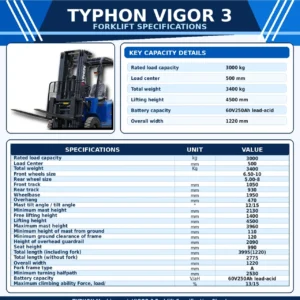
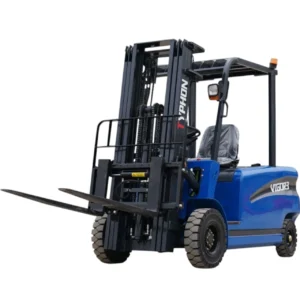
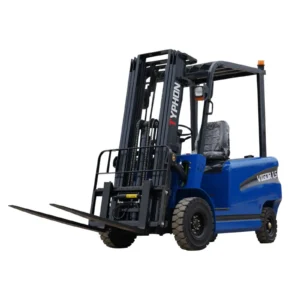
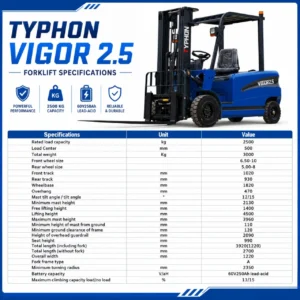
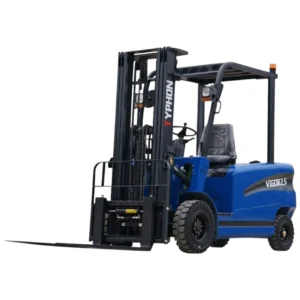
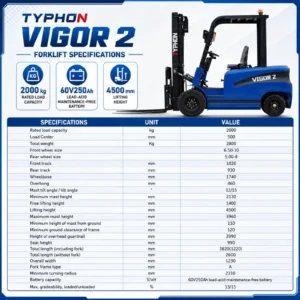
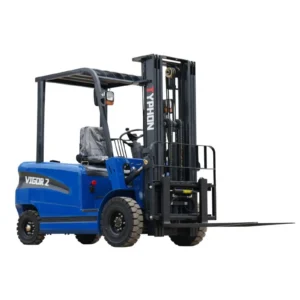
Our heavy-duty electric models weigh 7,500 lbs but deliver a massive rated lifting capacity of 6,600 lbs (at a 500 mm load center). This provides twice the lifting capacity of many standard warehouse machines on the market, allowing you to move heavier pallets in fewer trips.

How high can the forklift reach?

The machine features a maximum lifting height of 4.5 meters (approx. 14.7 feet) using a premium three-stage mast (1600mm, 3000mm, and 4500mm stages). Crucially, it includes 1400 mm of "free lift," meaning you can raise the forks inside low-ceiling areas or shipping containers without the mast hitting the roof.

How long does the battery last?

Powered by a high-efficiency 60V/250 Ah lead-acid battery, you get up to 10 hours of continuous operational runtime. It features a smart charging solution that plugs directly into any standard 110V outlet, fully recharging the machine in just 6 hours.

How much space do I need to turn the forklift?

Designed for tight warehouse navigation, the machine has a minimum turning radius of just 2530 mm. Combined with a compact body (2775 mm long, 1200 mm wide), a 1950 mm wheelbase, and lateral movement capabilities, operators can maneuver heavy loads safely in incredibly narrow aisles.

What kind of tires does this model use?

It is equipped with premium solid rubber tires. These provide maximum durability and absolute stability during heavy lifting operations. Because they are solid, they are 100% puncture-proof, eliminating flat-tire downtime on your warehouse floor.

Is it hard to steer with heavy loads?

Not at all. The machine is equipped with advanced hydraulic steering, ensuring the operator maintains precise, effortless control even when navigating tight corners with a full 6,600 lb payload.

Do I need a license to drive a forklift?

Yes. OSHA (Occupational Safety and Health Administration) requires all operators to be formally trained and certified by their employer to operate a powered industrial truck. Driving without certification is a major safety and liability risk.

Find the Perfect Forklift for Your Business Today

Don't let inefficient material handling throttle your profit margins. Browse our premium inventory of industrial lift trucks and scale your operations.

Cart

No products in the cart.

Select the fields to be shown. Others will be hidden. Drag and drop to rearrange the order.
  • Image
  • SKU
  • Rating
  • Price
  • Stock
  • Availability
  • Add to cart
  • Description
  • Content
  • Weight
  • Dimensions
  • Additional information
Click outside to hide the comparison bar
Compare