Increased Efficiency and Productivity
Time is the only important, non-renewable resource that every successful construction project needs. Your whole operation works better the faster your crew can finish a hard job without lowering the quality of their work. Unfortunately, delays that you can’t predict, outdated workflows, and extra manual labor costs are always threatening to cut into your carefully planned profit margins. Business owners need to find reliable ways to speed up their daily production schedules while still meeting the high standards that their customers expect.
This constant search for operational speed is where compact heavy equipment really shines for professional contractors. A mini skid steer revolutionizes work by simplifying complicated processes in ways that larger, clumsier machines cannot. These machines get rid of the constant friction that usually slows down a busy project because they are very responsive and easy to use.
In this full guide, we’ll show you exactly how adding a mini skid steer to your fleet can greatly boost your daily productivity. You’ll learn how these small powerhouses take the hard work out of manual labor, make it easier for you to move things around, and make the most of your on-site workflows. In the end, we’ll show how making operators more comfortable and reducing physical strain leads to a safer and much more profitable contracting business.
The High Cost of Manual Labor Workflows
Transporting materials and getting the site ready for work are the two most important steps in almost every construction and landscaping project. Crews have to move tons of topsoil, heavy pallets of bricks, and yards of wet concrete from the street to the work area all the time. In the past, contractors have relied on hard work from people to get these hard jobs done. They give their workers regular wheelbarrows and shovels, hoping that their hard work will keep the project on track.
The big problem with relying on manual labor is that it’s slow, very expensive, and bad for your workers’ health. There is a limit to how long people can work, and as the day goes on, your crew will naturally slow down because their muscles are so tired. This drop in physical output causes huge workflow problems, making your highly paid skilled tradesmen wait around for basic materials to show up. Also, pushing your workers to their limits will lead to a rise in expensive workers’ compensation claims and a lot of employees leaving.
With a mini skid steer, you don’t have to do any more tiring manual earthmoving because it brings mechanized power directly to the job. A single operator can easily do tasks that usually take three or four people pushing heavy wheelbarrows through thick mud. The machine picks up huge loads of heavy gravel with ease and moves them smoothly over the toughest terrain you can imagine. This quick switch from human power to hydraulic power changes the speed of your whole project in a big way.
This mechanization has a huge effect on the real world: it makes your daily completion rates go up by a lot and makes your crew’s work less physically demanding. You can keep your workers focused on the high-value installation work that makes money by moving them away from basic material transport. Your team stays fresh, motivated, and very productive from the first hour of the morning until the last bell rings. In addition to the physical work on the site, how quickly you can get your equipment to the project is also very important for efficiency.
Streamlining Equipment Transportation and Deployment
Getting a good contract across town is great news for your business, but moving your heavy equipment to that new location can be a huge pain in the neck. Moving heavy equipment is a complicated process that is heavily regulated and requires careful planning and a lot of money. When a contractor only uses big excavators or full-sized loaders, it becomes very hard for them to move from one job site to another.
The main problem with big machines is that they need special commercial trucks, very large trailers, and drivers who have commercial driver’s licenses (CDLs). It takes a lot of time and money to plan this huge transportation effort, and it costs hundreds of dollars in special fuel and permit fees. If the driver of your dedicated transport truck gets sick or the truck breaks down, your huge loader will be stuck on the storage lot. Every hour that machine has to wait for a ride is an hour of lost money and a big delay in your project.
Because of their small size and light weight, mini skid steers completely avoid this huge logistical nightmare. You don’t need a big commercial semi-truck to move these machines around the county. A regular heavy-duty pickup truck and a basic utility trailer can easily carry a mini skid steer and some of its most important attachments. In the morning, your foreman can easily hook up the trailer, load the machine in less than five minutes, and drive straight to the new job site.
This easier transportation process cuts down on your logistical downtime by a lot and cuts your heavy equipment transport budget by a lot. Contractors who work on a lot of small projects in different neighborhoods can easily move the machine two or three times in one day without it getting in the way of their work. Less time spent dealing with complicated logistics means a lot more time spent doing real work that can be billed. Once the machine is successfully taken off the trailer, the next most important thing for your bottom line is how well it can move around the site.
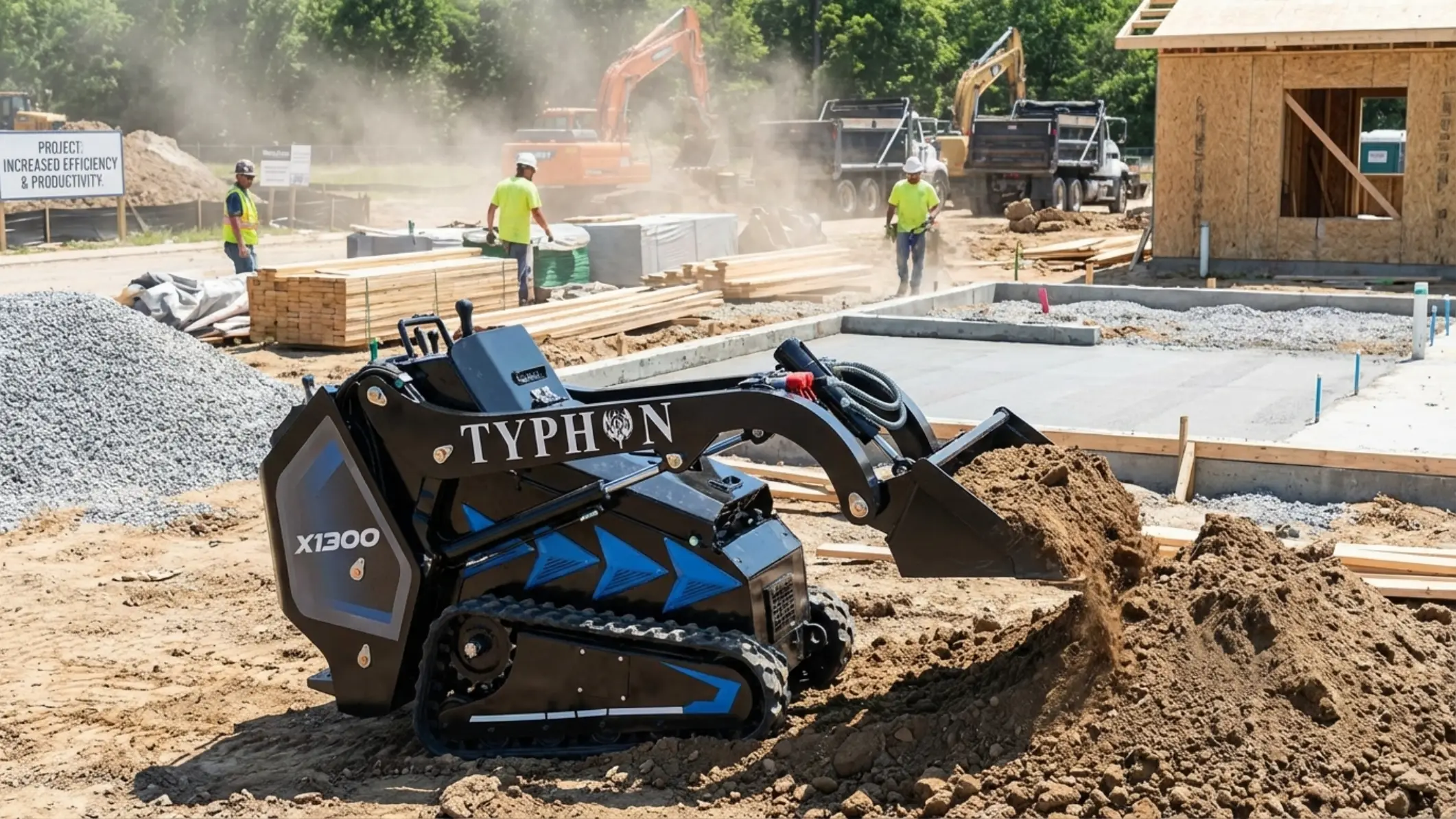
Rapid Positioning and Workflow Optimization
A busy construction site is a messy place with workers moving around, building materials scattered everywhere, and fragile structures that are already there. To get through this maze, you need equipment that can move exactly without getting in the way of the work going on around it. When operators have to use big, heavy loaders in these crowded areas, their main goal changes from working quickly to just avoiding terrible crashes.
The biggest problem with big machines is that it takes a long time to set them up for a simple job. A full-sized loader can’t just turn around in a small backyard; the driver has to make a series of slow, painful multi-point turns. The machine’s constant, awkward repositioning makes the rest of the crew stop working and clear the area until it finally faces the right way. These constant interruptions break up the flow of work, which causes a chain reaction of delays that can add days or even weeks to your project’s timeline.
A mini skid steer is small and has very responsive controls, which lets operators move the machine quickly and precisely. The machine can turn a full three hundred and sixty degrees without leaving its own footprint because the tracks work on their own. The operator can scoop up a load of topsoil, turn around right away, and go straight to the grading zone without ever touching the reverse lever. This smooth, constant motion gets rid of all the annoying delays that come from having to move equipment around awkwardly.
Keeping a steady, smooth rhythm lets your whole crew work at their best all day long. The mini skid steer moves easily around piles of materials and active trenches, bringing supplies exactly when and where they are needed. This level of workflow optimization makes sure that every hour of work you pay for is used to its fullest potential. Of course, the machine can only move as smoothly as the person using it, which is why endurance is so important.
Elevating Operator Comfort and Sustained Focus
Operating heavy machinery is a tough job that requires constant awareness of the situation and precise physical coordination. The machine doesn’t get tired, but the person pulling the levers does. Contractors often don’t realize how much eight to ten hours of continuous heavy equipment operation affects their workers’ bodies and minds.
When an operator has to use a poorly designed machine that shakes violently or needs a lot of physical strength to control, they get very tired very quickly. An operator who is tired works slowly. As their muscles hurt and they can’t concentrate, they naturally slow down and start making mistakes that are easy to avoid. This big drop in productivity in the afternoon makes your daily output go way down and messes up the exact finishing work needed for high-end landscaping or grading.
Engineers who design modern mini skid steers know a lot about how people work and how to make them comfortable. Operators don’t have to fight with stiff, mechanical levers; instead, they Use hydraulic joysticks that are very easy to use and respond to even the smallest touch. The ride-on platforms are also suspended and have a lot of padding, which helps them absorb the harsh impacts and vibrations of rough terrain. These important design features may seem like small luxuries, but they really change how an operator feels after a long shift.
If your operators are comfortable and don’t have any joint pain, they can easily stay very focused from morning until night. This long-lasting mental clarity leads to better, more accurate results and a huge drop in expensive mistakes made during operations. Your crew will grade the soil more evenly, dig trenches more straight, and move materials more quickly because they won’t be fighting the machine. This better focus naturally makes the work site a much safer and more controlled place for everyone.
Enhancing Job Site Consistency and Safety
To give your clients a high-quality product, you need to be completely consistent at every stage of the construction process. The quality must stay the same, whether you are digging thirty holes for fence posts or perfectly leveling a huge commercial concrete pad. It’s almost impossible to get this level of mechanical perfection when you rely on a manual workforce that gets tired quickly.
The inherent issue with human labor is that the quality of the work diminishes as physical exertion intensifies. The first ten holes that a manual crew digs will probably be straight and level. But by the thirtieth hole, tired workers will start to cut corners, dig shallow, and make mistakes that aren’t very good just to get the job done. Because of this lack of consistency, your foremen have to waste time checking, fixing, and completely redoing tasks that aren’t up to par.
Using a mini skid steer to automate these repetitive tasks makes sure that everything stays the same from the start of the project to the end. An auger attachment that runs on steady hydraulic pressure will dig the fiftieth hole just as well as it dug the first. This perfect accuracy means you won’t have to do any annoying rework, so your next installation phases will go off without a hitch. The first time you use your building materials, they will fit perfectly, saving you a lot of time and money on raw materials.
Replacing tired manual workers with precise machines greatly increases the safety of your job site, not just for consistency. Operators who are alert, comfortable, and use equipment that responds quickly are much less likely to cause accidents or drop heavy things. You protect your most valuable business asset—your people—by keeping them out of the direct line of fire. The main goal of any serious contracting business is to keep your crew safe and speed up your timelines.
Maximizing Overall Project Profitability
Your contracting business is there to make money that is healthy and long-lasting. You carefully figure out how much to bid based on how many hours of work you expect, how much the equipment will cost, and material expenses. However, those calculated margins vanish instantly when a project is derailed by unpredictable delays, exhausted workers, or inefficient material handling.
The main problem that contractors have is that they can’t control these hidden job site variables. When you use old workflows, you’re basically betting that your crew won’t get hurt, the big truck won’t break down, and the weather will stay nice long enough to finish the work. This reactive way of managing projects makes your finances very unstable and stops you from confidently growing your business. You need to set up a proactive system that fiercely guards your time and money.
Adding a very efficient mini skid steer to your daily work will help you control those unpredictable factors. You have full control over your transportation logistics, which greatly reduces your need for manual labor and keeps your workflow going without a hitch. You can always finish complicated projects days ahead of schedule because the machine is so fast and dependable. Finishing early cuts your total payroll costs for that job by a huge amount, which means you get pure profit right away.
You can bid on bigger, more complicated projects with complete confidence because of this higher level of financial predictability. You know exactly how quickly your mechanized crew can work, so you can aggressively undercut competitors who still use slow, manual processes. Putting money into compact efficiency isn’t just about moving dirt; it’s also about creating a business model that makes a lot of money and can grow faster than the rest of the industry.
Elevate Your Operational Standards Today
No matter what job site you’re on, time will always be your most valuable asset. In the modern construction industry, the best way to get ahead of your competitors is to be able to do more work in less time without lowering your high standards of quality. Using big, heavy machines or doing things the old-fashioned way slows you down and takes away from your hard-earned profits. You need tools that understand how important your business is and follow your orders right away.
A mini skid steer is the most efficient machine because it combines fast transport, precise maneuverability, and endless hydraulic power into one easy-to-use platform. These machines keep your projects moving forward without stopping by keeping your crew from getting physically exhausted and getting rid of logistical problems. Don’t let old workflows stop your business from making as much money as it could. Figure out how much time you waste on operational delays, how many hours of labor you waste, and then confidently upgrade your fleet to make sure that every project you take on is as profitable as possible.
Explore more about Cost-Effective Investment and Operation?
Comments (5)
Versatility Through Multi-Functional Attachments
April 8, 2026[…] Explore more about Increased Efficiency and Productivity? […]
Randall844
April 23, 2026https://shorturl.fm/s8Y5h
Ricky2334
April 24, 2026https://shorturl.fm/PnSNY
Norman4998
April 24, 2026https://shorturl.fm/vZkXo
Bailey3947
April 24, 2026https://shorturl.fm/7OAV1