
Introduction
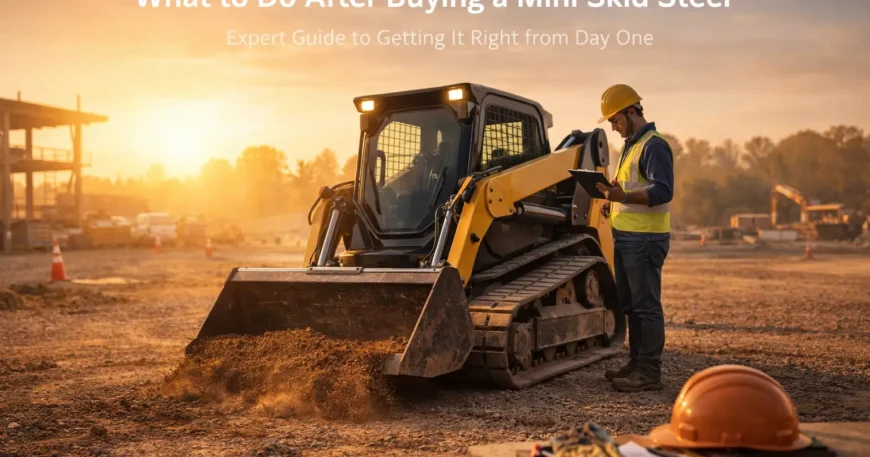
Purchasing a mini skid steer often feels like a turning point for contractors and business owners. It’s not just another piece of equipment—it’s a step toward greater efficiency, independence, and job capability. Yet, what many new owners underestimate is that the real value of the machine is not unlocked at the moment of purchase, but in the decisions made immediately after.
Too often, machines that should deliver years of reliable performance begin to show early signs of wear, inefficiency, or even failure—not because of manufacturing issues, but because of overlooked fundamentals during the first days of ownership. The difference between a machine that becomes a long-term asset and one that turns into a costly liability often comes down to how it is introduced into operation.
Understanding what to do after buying a mini skid steer is not about following a checklist—it’s about setting a foundation for performance, durability, and return on investment.
Understanding Your Machine Beyond the Surface(Mini Skid Steer)
When a new mini skid steer arrives on-site, the natural instinct is to put it straight to work. After all, time is money, and every idle hour feels like lost productivity. However, rushing into operation without truly understanding the machine is one of the most common and costly mistakes.
Every skid steer, regardless of brand or model, has its own operational characteristics. Hydraulic response, load balance, control sensitivity, and attachment behavior can vary in subtle but important ways. Without taking the time to understand these nuances, operators often compensate unconsciously—leading to inefficient movements, increased fuel consumption, and unnecessary strain on components.
Spending time with the machine in a controlled environment allows operators to build a sense of control that cannot be learned under pressure. This early familiarity translates directly into smoother operation, reduced wear, and a noticeable improvement in job site precision. More importantly, it establishes a level of confidence that prevents hesitation or overcorrection during real work scenarios.
This deeper understanding naturally leads to a more important realization: performance is not just about operation—it begins with condition.
Establishing a Baseline Through Initial Inspection
Even brand-new machines are not immune to imperfections. Transport vibrations, assembly tolerances, and environmental exposure during shipping can all introduce minor issues that, if left unchecked, evolve into major problems.
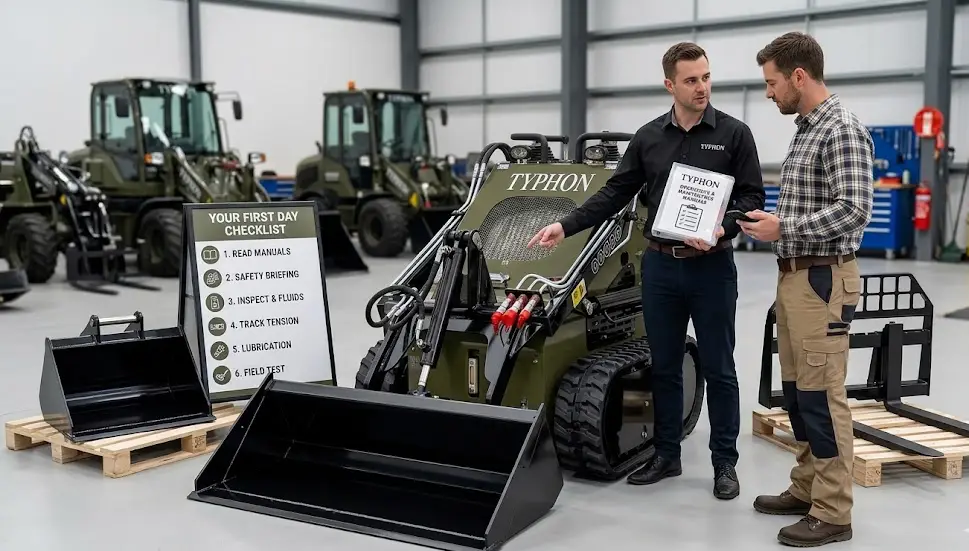
The initial inspection is not simply a precaution—it is the moment where ownership truly begins. By carefully examining fluid levels, hydraulic connections, fasteners, and moving parts, operators establish a baseline condition for the machine. This baseline becomes a reference point for all future maintenance and troubleshooting.
What makes this step critical is not just the act of checking, but the awareness it creates. When an owner knows exactly how the machine looked, sounded, and performed at the beginning, any deviation becomes immediately noticeable. This early detection capability can prevent downtime, reduce repair costs, and extend the overall lifespan of the equipment.
With a clear understanding of the machine’s condition, attention naturally shifts toward how it is used in its earliest hours.
Breaking In the Machine the Right Way
The first hours of operation are often the most underestimated phase of a machine’s life. While modern engines and hydraulic systems are built with precision, they still require a period of gradual adaptation under load.
Pushing a new mini skid steer to its limits too early can create microscopic wear patterns that compromise long-term efficiency. Components such as piston rings, hydraulic seals, and bearings need time to settle into their optimal working state. When this process is rushed, the result is often reduced performance and increased maintenance requirements later on.
A controlled break-in period allows the machine to adapt under varying loads and speeds. This approach not only protects internal components but also provides operators with a better understanding of how the machine responds under different conditions. Over time, this leads to more intuitive operation and a noticeable improvement in fuel efficiency and power delivery.
As the machine begins to settle into regular use, another critical factor comes into play—how well it is supported through maintenance.
Building Maintenance Habits That Prevent Downtime
In the construction world, downtime is more than an inconvenience—it is a direct hit to profitability. Yet, many equipment owners fall into a reactive maintenance mindset, addressing issues only after they become visible or disruptive.
The most successful operators take a different approach. They treat maintenance as a continuous process rather than an occasional task. From the very beginning, small habits such as regular cleaning, consistent lubrication, and routine checks become part of daily operations.
What makes these habits powerful is their cumulative effect. A machine that is consistently maintained experiences less friction, fewer unexpected failures, and a longer operational life. It also retains its performance characteristics, allowing operators to work with the same level of efficiency months or even years after purchase.
This consistency creates reliability—and reliability is what allows a machine to truly integrate into a business workflow.
Choosing and Using Attachments Strategically
One of the defining advantages of a mini skid steer is its versatility. With the right attachments, a single machine can perform the work of multiple specialized tools. However, this versatility can quickly become a weakness if attachments are chosen or used without strategy.
Each attachment changes the way the machine distributes weight, applies force, and interacts with the ground. Using the wrong attachment—or using the right one incorrectly—can reduce efficiency and place unnecessary stress on the machine.
Experienced operators understand that attachments are not just accessories; they are extensions of the machine’s capability. Selecting the right attachment for each task ensures smoother operation, faster completion times, and reduced wear on both the machine and the attachment itself.
As attachment use becomes more refined, the focus naturally shifts toward protecting the machine when it is not actively working.
Protecting Your Investment Through Proper Storage and Care
A mini skid steer does not stop aging when it is turned off. Environmental factors such as moisture, heat, and dust continue to affect its components even when it is idle. Over time, improper storage can lead to corrosion, electrical issues, and premature degradation of materials.
Proper storage is often overlooked because it does not produce immediate results. However, its long-term impact is significant. Keeping the machine in a controlled environment, protecting it from extreme conditions, and ensuring it is clean before storage all contribute to preserving its condition.
This level of care extends the machine’s lifespan and maintains its resale value. More importantly, it ensures that when the machine is needed, it is ready to perform without delay or complication.
Conclusion
Owning a mini skid steer is not just about having the right equipment—it is about managing an asset that has the potential to transform how work gets done. The actions taken immediately after purchase set the tone for everything that follows, from daily performance to long-term reliability.
By approaching ownership with intention—taking the time to understand the machine, establishing strong maintenance habits, and operating with care—contractors and business owners can unlock the full value of their investment. The result is not just a machine that works, but one that consistently delivers efficiency, dependability, and professional results.
In an industry where margins are tight and expectations are high, that level of performance is not optional—it is essential.
Comments (7)
Reduced Ground Impact and Surface Damage - skidsteerloaders.org
April 8, 2026[…] more about What to Do After Buying a Mini Skid Steer […]
Minimize Site Damage with Low-Impact Mini Skid Steers
April 8, 2026[…] more about What to Do After Buying a Mini Skid Steer […]
Haleigh4272
April 23, 2026https://shorturl.fm/17oze
Payton2353
April 23, 2026https://shorturl.fm/M3RP6
Eliza186
April 24, 2026https://shorturl.fm/7sc0p
Grace4264
April 24, 2026https://shorturl.fm/bJDMJ
Enrique707
April 24, 2026https://shorturl.fm/vWBRf